
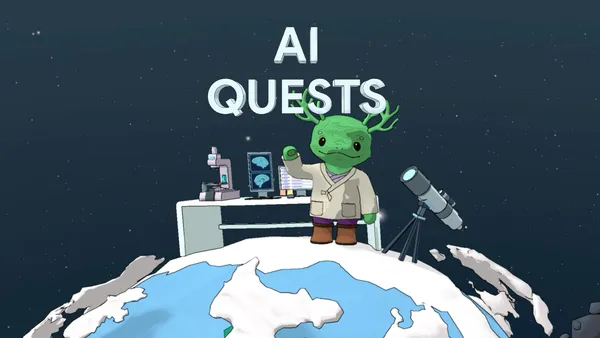
If you have spent any time trying to upskill in machine learning lately, you know the pain of dry documentation and endless video tutorials that never quite match production realities. Google just dropped a fresh entry in its educational series called Polar Peaks, blending applied neuroscience with prompt engineering. As a developer who tracks every new AI tools update, I wanted to see if this interactive quest offers actual technical value or if it is just another marketing wrapper for basic chatbots.
What Changed Under the Hood in Polar Peaks
Unlike standard text-based prompt tutorials, Polar Peaks forces you to structure inputs around spatial data constraints, mimicking how researchers map neural pathways. Under the hood, the module tests your ability to guide large language models through structured JSON outputs, multi-turn context retention, and strict parameter enforcement.
When building production apps, we rarely need generic conversational agents. We need deterministic data parsing. This quest leans heavily into teaching developers how to constrain model outputs, which directly feeds into better workflow automation scripts. By treating neural mapping data as a series of graph databases and vector embeddings, the curriculum bridges the gap between theoretical AI literacy and messy, real-world data pipelines.
Practical Use Cases for Remote Teams and Builders
Remote engineering teams are constantly looking for interactive ways to onboard junior developers or cross-train backend specialists into machine learning operations. Polar Peaks offers a structured sandbox without the heavy setup friction usually associated with spinning up local Python environments or paying for hefty GPU cloud instances.
- Rapid Onboarding: Get remote team members up to speed on LLM constraints and token management in under an hour.
- Data Pipeline Simulation: Practice parsing unstructured scientific logs into clean schemas that integrate smoothly with your existing CI/CD pipelines.
- API Integration Drills: Learn how to handle rate limits, timeouts, and fallback responses when querying complex scientific datasets.
Step-by-Step Workflow Impact on Developer Productivity
Let us talk about the daily grind. How does spending an hour in a gamified neuroscience quest actually affect your developer productivity? The real win here is pattern recognition. When you spend time forcing an LLM to accurately categorize complex biological entities without hallucinating, you sharpen your prompt architecture skills.
Consider a standard task involving API integration where you pull JSON payloads from a third-party service and feed them into an internal model. If your prompts lack strict schemas, your application breaks. Polar Peaks drills you on exact formatting rules, reducing the trial-and-error cycle you usually face when deploying new endpoints.
Comparing Google’s Quest to Existing Alternatives
How does this stack up against traditional courses on platforms like Coursera or open-source tutorials on GitHub? Let us break down the trade-offs in the table below.
| Feature | Google AI Quests | Traditional Video Courses | Open-Source Repositories |
|---|---|---|---|
| Setup Friction | Zero (Browser-based) | Low to Moderate | High (Local dependencies) |
| Interactivity | High (Hands-on sandbox) | Low (Passive watching) | Variable (Code-your-own) |
| Cost | Free access | Subscription required | Free (Community supported) |
While open-source AI projects give you total control over the weights and code, they demand significant time to configure local virtual environments, manage CUDA drivers, and resolve dependency conflicts. Google’s quest trades raw codebase access for immediate, frictionless execution, making it ideal for a quick lunch-hour skill refresh.
Evaluating Compute Realities and LLM Benchmarks
It is worth keeping a healthy dose of skepticism regarding how these educational quests relate to actual enterprise workloads. Standardized LLM benchmarks rarely account for domain-specific edge cases in specialized fields like neuroscience or genomics. While Polar Peaks does a fantastic job of teaching basic structural constraints, production applications require robust fallback mechanisms, strict latency budgets, and rigorous safety evaluations that simple browser sandboxes cannot fully simulate.
If you are building products that rely on high-throughput data processing, you will still need to benchmark models locally, test against custom test suites, and monitor token consumption closely. Treat this quest as a mental gymnasium rather than a production deployment guide.
Final Thoughts for Builders
If you want to sharpen your ability to steer large language models and manage complex data inputs without getting bogged down in heavy textbook reading, Polar Peaks is worth thirty minutes of your afternoon. It will not magically turn you into a senior neuroscientist or a principal machine learning engineer, but it will give you sharper tools for prompt structuring and data parsing.
You can check out the official announcement and dive into the interactive modules directly by visiting the Google AI Quests Polar Peaks Guide.