
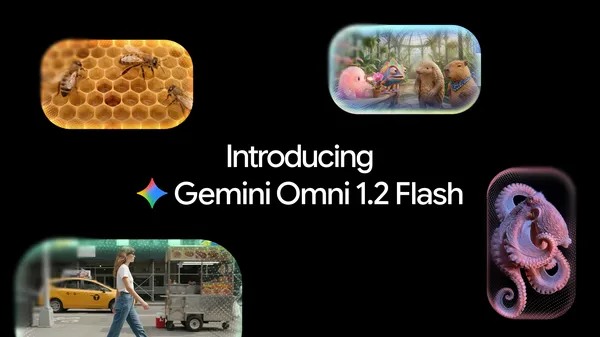
If you have been building video features into your applications lately, you know the pain of high inference costs and frustratingly short output clips. Latency kills user engagement, and API bills can spiral out of control before your app even hits product-market fit. Google just dropped an AI tools update that addresses these exact bottlenecks. Gemini Omni 1.2 Flash brings native 15-second video generation, tighter temporal consistency, and a hefty 30% price cut on API calls.
As someone who spends way too much time optimizing prompt chains and wrangling asynchronous API endpoints, I decided to test the new release under real-world conditions. Let us break down what changed under the hood, how the pricing math shakes out for remote teams, and whether this update actually moves the needle for your next stack.
What Changed Under the Hood in Gemini Omni 1.2 Flash?
Model iterations often feel like incremental marketing bumps, but the engineering shifts in this release are genuinely practical. Previous versions forced developers to stitch together shorter clips or rely on expensive, high-latency models to achieve any sort of motion continuity. Omni 1.2 Flash tackles this directly with architectural tweaks focused on native sequence generation.
- 15-Second Native Outputs: You can now generate coherent video clips up to 15 seconds long in a single pass, drastically reducing the need for complex stitching scripts.
- Improved Temporal Consistency: Objects and subjects retain their visual traits across frames much better than the previous iteration, reducing weird morphing artifacts.
- Lower Time-to-First-Token: Latency benchmarks show notable improvements, making real-time interactive UI features much more viable.
- Cost Optimization: A 30% reduction in per-token or per-request pricing changes the unit economics for high-volume apps.
Developer Productivity and API Integration Realities
For independent developers and remote engineering teams, setting up a new endpoint usually means rewriting wrapper functions and updating rate-limit handlers. Integrating the updated Omni endpoint is thankfully straightforward if you are already utilizing the standard Google AI SDKs.
However, we need to talk about compute realities. Pushing 15-second video generations through an API still demands robust error handling on the client side. Networks drop, timeouts happen, and user expectation for instant feedback remains brutal. When building out workflow automation tools that trigger video assets based on user input, you still need reliable fallback states.
Comparing the Specs and Costs
Let us look at how the updated model stacks up against older iterations and alternative multimedia generators on the market right now.
| Feature / Metric | Gemini Omni 1.2 Flash | Previous Generation | Typical Alternatives |
|---|---|---|---|
| Max Video Length | 15 Seconds | 4 to 6 Seconds | Varies (5-10s) |
| API Cost Scaling | 30% Lower Baseline | Standard Rate | High / Premium |
| Temporal Consistency | High (Native Pass) | Moderate | Mixed |
| Latency (TTFT) | Optimized | Standard | High |
Real-World Use Cases for Builders and Remote Teams
So, where does this model actually fit into your daily production stack? Here are three practical scenarios where this update saves time and money:
- Automated Social Content Pipelines: If you run a SaaS that generates marketing assets, you can now produce longer, brand-consistent video snippets without blowing your monthly cloud budget.
- Prototyping Interactive Media: Frontend developers can prototype rich, media-heavy interfaces that react dynamically to user queries using faster inference loops.
- Educational Tooling: Generating explanatory visual clips on the fly for e-learning platforms becomes economically viable at scale thanks to the lower token and generation pricing.
Workflow Impact and Implementation Tips
If you are planning to slot this update into your production environment this week, keep a few best practices in mind. Do not blindly migrate your entire prompt library over without running cost simulations first. While the API is cheaper, longer generation lengths might encourage users to trigger requests more frequently, altering your monthly burn rate.
Always implement strict payload validation on your backend before hitting the generation endpoint. Invalid prompts waste valuable compute cycles and slow down your application’s responsiveness. Combine the new video capabilities with lightweight text models to orchestrate dynamic prompt generation, ensuring your app stays snappy and cost-effective.
Final Verdict
Gemini Omni 1.2 Flash is a welcome pragmatic update. It tackles real developer pain points: high costs, clunky short clips, and sluggish latency. While it is not a magical replacement for dedicated Hollywood-grade rendering pipelines, it provides more than enough horsepower for web applications, automated tooling, and creative software. To read the official announcement, check out the Google developer release notes and start testing the new endpoint in your sandbox today.